Few kitchen debates are as persistent as this one: does heat destroy turmeric’s medicinal value? As turmeric transitions from ancient kitchens to modern wellness culture, many assume that raw consumption is superior. But both traditional practice and scientific research suggest a more nuanced answer.
To understand what cooking does to turmeric, we need to examine its most studied compound curcumin and how it behaves under heat.
What Happens to Curcumin When Heated?
Turmeric’s primary bioactive compound, curcumin, is responsible for much of its antioxidant and anti-inflammatory research interest. However, curcumin is chemically sensitive.
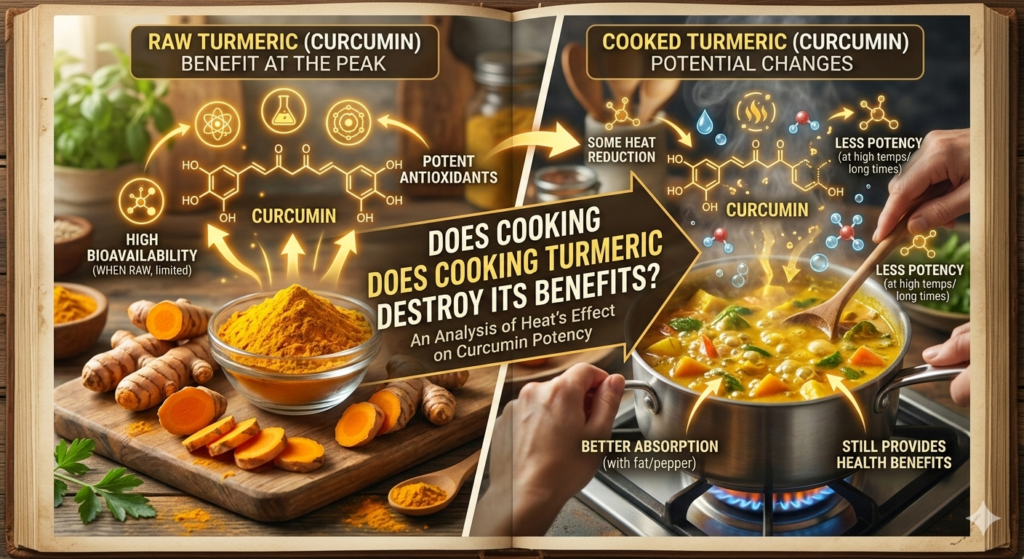
Laboratory studies indicate that prolonged high heat can degrade curcumin to some extent. But degradation does not automatically mean total loss of biological activity. In typical culinary conditions simmering in curries or sautéing in oil turmeric is not exposed to extreme temperatures for extended periods.
In fact, moderate heating may actually improve its solubility.
Why Traditional Cooking Methods Matter
Across Indian cuisine, turmeric is rarely consumed raw. It is:
- Bloomed in oil at the beginning of cooking
- Simmered in lentils and stews
- Combined with black pepper
- Cooked alongside fats like ghee or coconut oil
This traditional technique may unintentionally solve curcumin’s biggest challenge: low bioavailability.
Curcumin is fat-soluble, meaning it dissolves better in oils than in water. When turmeric is sautéed in oil, absorption potential increases. Additionally, black pepper contains piperine, a compound shown to significantly enhance curcumin absorption.
So while some curcumin may degrade slightly under heat, cooking can simultaneously increase the amount the body actually absorbs.
Is Raw Turmeric More Potent?
Raw turmeric root from the species Curcuma longa contains intact curcuminoids and volatile oils. It is often added to:
- Smoothies
- Cold-pressed juices
- Wellness shots
However, raw turmeric presents two challenges:
- Poor absorption without fat or piperine
- Potential digestive irritation in large quantities
Simply consuming raw turmeric does not guarantee better outcomes. Without the presence of fat or black pepper, much of the curcumin may pass through the digestive system unabsorbed.
What Research Suggests About Stability
Studies examining thermal stability show:
- Short cooking times cause partial degradation, not complete destruction.
- Curcumin breaks down more significantly at very high temperatures (such as prolonged frying).
- Cooking in water alone may reduce concentration more than cooking in oil.
This suggests that how turmeric is cooked matters more than whether it is cooked.
Gentle simmering in oil-based dishes appears to preserve functional value more effectively than dry overheating.
The Golden Milk Example
“Golden milk,” a preparation rooted in Ayurvedic practice, combines turmeric with milk (or plant milk), black pepper, and sometimes ghee. The fat content enhances solubility, and the heat helps dispersion.
Rather than diminishing turmeric’s benefits, this method may actually optimize them.
Traditional knowledge systems like Ayurveda emphasized preparation methods — a reminder that plant medicine has always been about synergy, not isolated compounds.
Practical Takeaways for the Kitchen
- If your goal is to preserve turmeric’s potential benefits:
- Avoid prolonged high-heat dry roasting
- Cook turmeric with healthy fats
- Pair with black pepper
- Add turmeric early in cooking to bloom in oil
- Do not rely solely on raw consumption
Cooking does not “destroy” turmeric in ordinary culinary contexts. Instead, proper preparation may enhance its practical effectiveness.
The idea that raw equals better is largely a modern wellness narrative. For thousands of years, turmeric was consumed cooked in curries, broths, and medicinal preparations.
Rather than asking whether cooking destroys turmeric, a better question might be: are we preparing it intelligently?
Understanding heat, fat, and synergy allows us to move beyond myths and toward informed culinary use.