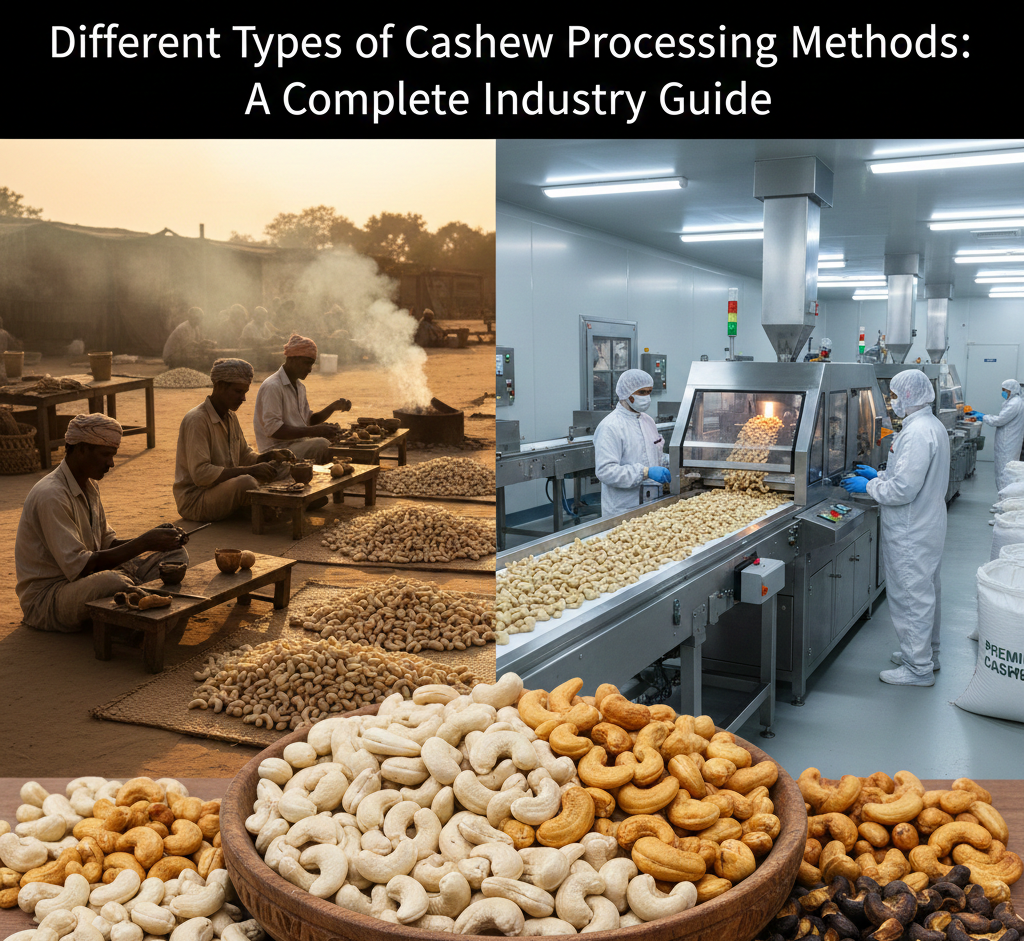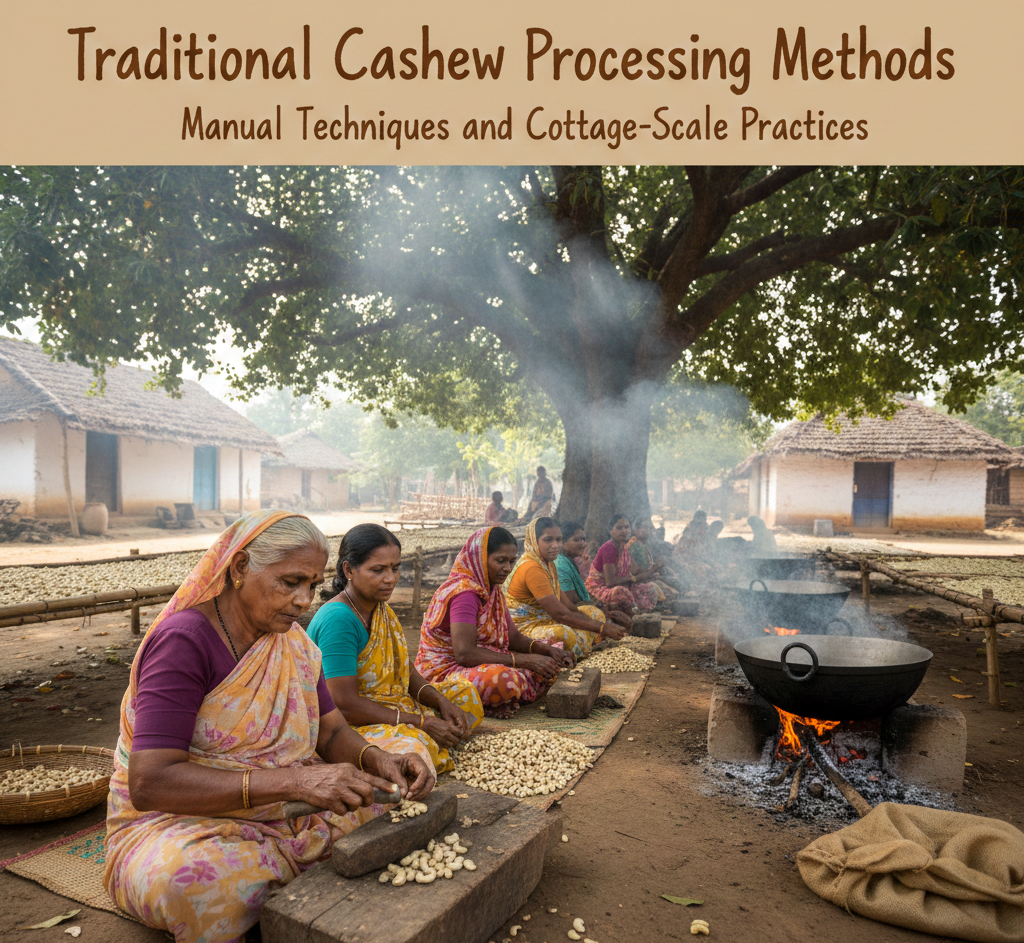
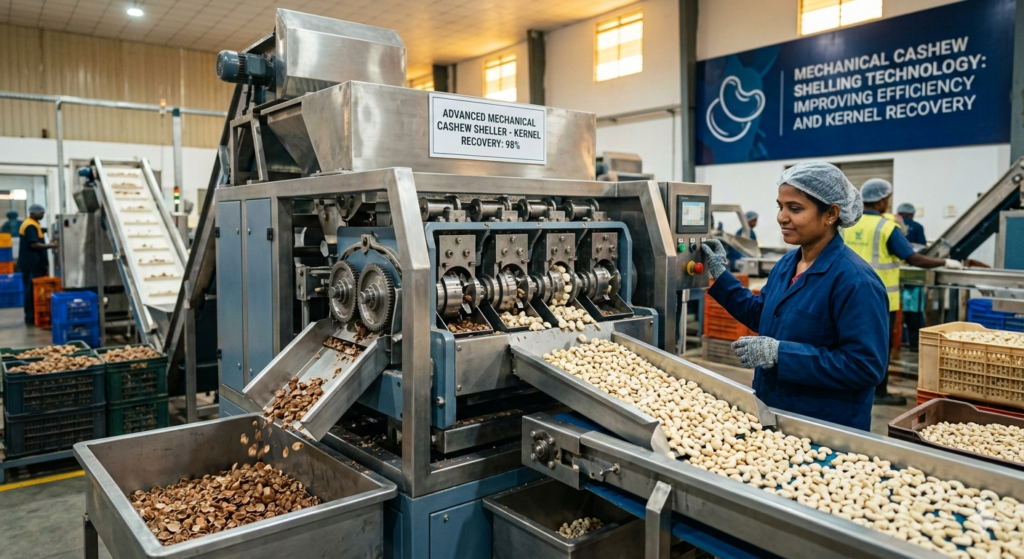
Mechanical shelling technology represents a major shift in the evolution of cashew processing. Positioned between manual shelling and full automation, mechanical systems significantly improve productivity while reducing labour intensity and kernel breakage.
As labour costs rise and export standards become stricter, many processors are turning to mechanical shelling to enhance operational efficiency without immediately investing in fully automated plants.
This article explores how mechanical cashew shelling works, its advantages, limitations, and its strategic importance in modern processing facilities.
What Is Mechanical Cashew Shelling?
Mechanical cashew shelling refers to the use of semi-automatic or fully mechanical cutting machines to crack the outer shell of steam-treated or roasted cashew nuts.
Unlike manual shelling which depends entirely on worker skill mechanical systems use calibrated blades or cutters designed to apply uniform pressure. These machines are typically integrated after roasting, especially in steam-based processing units.
Mechanical shelling has gained widespread adoption in major processing nations such as India and Vietnam, where scaling production while maintaining quality is critical.
How Mechanical Shelling Works
Feeding and Alignment
Pre-treated nuts are fed into the machine either manually or through automated feeders. The equipment aligns each nut to ensure precise cutting.
Proper alignment is crucial to prevent crushing or splitting the kernel.
Shell Cutting Mechanism
The machine uses sharp, calibrated blades or pressure systems to crack the shell at specific points. The goal is to break the shell cleanly without damaging the kernel inside.
Because the cutting force is standardised:
- Breakage rates are reduced
- Output consistency improves
- Processing speed increases
Kernel Separation
Once the shell is cracked, kernels are separated either manually or through mechanical separation units. Workers may still inspect kernels to ensure quality and remove residual shell fragments.
Mechanical shelling reduces the physical strain associated with traditional cracking methods.
Advantages of Mechanical Shelling Technology
Mechanical shelling offers multiple operational and commercial benefits.
- It increases productivity significantly compared to manual methods. A single machine can process hundreds of kilograms per day, depending on capacity.
- It reduces dependence on skilled manual labour, which can be scarce or expensive in certain regions.
- It improves whole kernel recovery rates when combined with proper roasting techniques.
- It enhances uniformity, which is essential for maintaining consistent grading standards in export markets.
Mechanical shelling also supports better hygiene control, aligning with international food safety expectations influenced by global frameworks such as those developed by the Codex Alimentarius Commission.
Limitations and Operational Considerations
Despite its advantages, mechanical shelling is not without challenges.
- Initial capital investment is higher than manual shelling.
- Machines require regular maintenance and skilled operators to ensure optimal performance.
- Improper calibration can increase kernel breakage, particularly if nuts are uneven in size or insufficiently conditioned.
Mechanical systems also work best when integrated with consistent pre-treatment processes such as steam roasting. Poor roasting quality can reduce shelling efficiency.
Mechanical Shelling vs Manual Shelling
Compared to manual shelling, mechanical technology provides:
- Higher daily processing capacity
- More consistent output
- Reduced physical strain on workers
- Lower long-term labour costs
However, manual shelling may still achieve slightly higher precision in certain small-batch operations handled by highly experienced workers. For most medium-scale processors, mechanical shelling offers the best balance between cost and efficiency.
Role in Medium-Scale Processing Units
Mechanical shelling is particularly suitable for:
- Medium-scale processing plants
- Units transitioning from traditional systems
- Businesses preparing for export expansion
- Regions facing labour shortages
Many processors adopt mechanical shelling as a transitional step before investing in fully automated processing lines.
In established cashew-exporting countries such as India and Vietnam, mechanical shelling has become a standard component of semi-modern processing facilities.
Strategic Importance in Modern Cashew Processing
For entrepreneurs evaluating different types of cashew processing methods, mechanical shelling represents a scalable upgrade path. It enhances productivity, reduces operational risk, and supports quality improvement without the financial burden of full automation.
When integrated with steam roasting and structured grading systems, mechanical shelling significantly strengthens competitiveness in both domestic and international markets.