The drum roasting method is a semi-modern cashew processing technique that evolved as an improvement over traditional open-pan roasting. It introduced greater roasting uniformity and higher throughput while remaining less capital-intensive than steam-based systems.
Although many export-oriented plants now prefer steam roasting, drum roasting continues to be used in several processing regions due to its operational simplicity and moderate investment requirements.
This article explains how the drum roasting method works, its advantages and limitations, and its relevance in today’s cashew industry.
What Is the Drum Roasting Method?
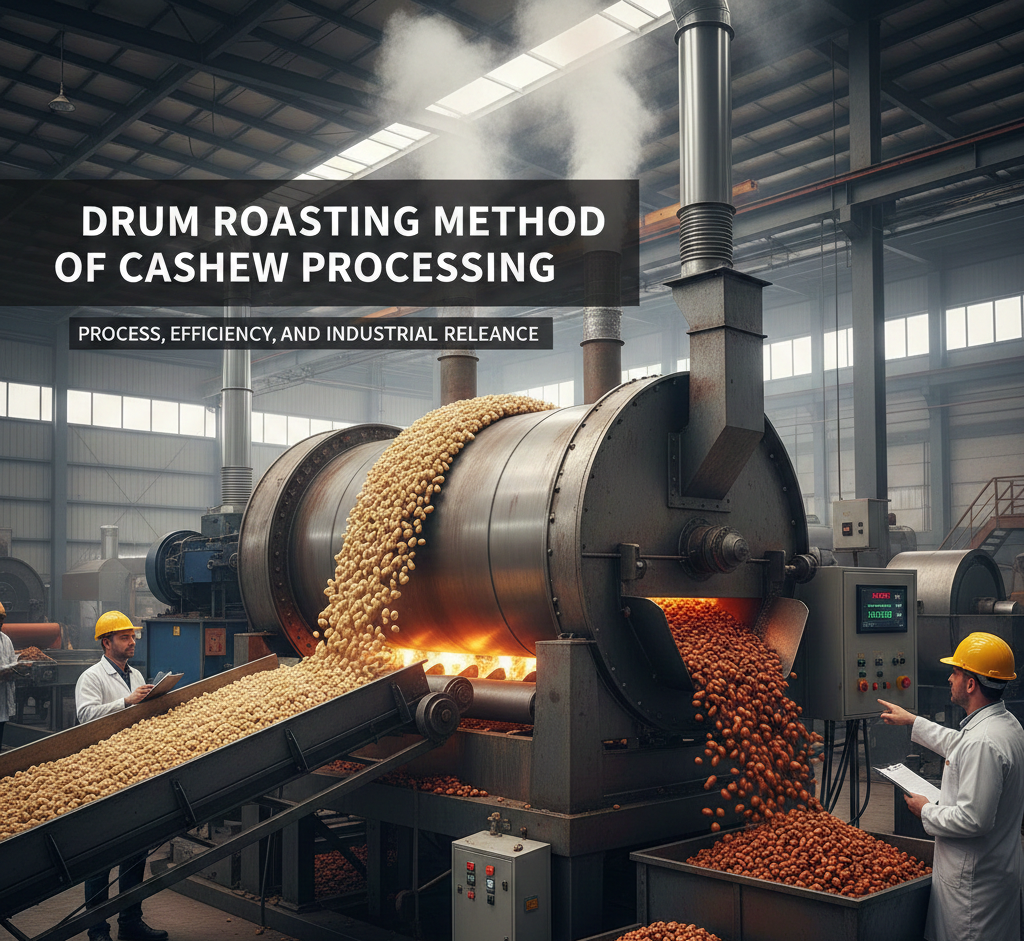
Drum roasting involves heating raw cashew nuts inside a rotating metal drum, typically powered by firewood, gas, or other combustible fuel. The rotating mechanism ensures that nuts are continuously turned during roasting, promoting more even heat distribution compared to stationary open-pan methods.
The method gained popularity in major producing regions such as India and parts of West Africa, where processors sought higher efficiency without transitioning fully to steam systems.
Drum roasting is primarily designed to loosen the hard shell and partially release or coagulate cashew nut shell liquid (CNSL) before shelling.
Step-by-Step Drum Roasting Process
Pre-Drying of Raw Nuts
Before roasting, raw cashew nuts are sun-dried or mechanically dried to reduce surface moisture. Proper drying ensures consistent roasting and reduces the risk of uneven heating.
Loading into the Rotating Drum
The dried nuts are loaded into a cylindrical metal drum positioned over a heat source. The drum rotates continuously during operation.
Rotation ensures:
- Even exposure to heat
- Reduced burning on one side
- Improved roasting consistency compared to static roasting
- High-Temperature Roasting
The nuts are roasted at high temperatures for a fixed duration, depending on batch size and moisture content. During roasting:
- The shell hardens externally
- CNSL heats up and may partially drain
- Internal moisture redistributes
Operators monitor the roasting process carefully to avoid over-burning, which can affect kernel colour and taste.
Cooling and Shelling
After roasting, the nuts are discharged and allowed to cool. Cooling stabilises the kernel and prepares the nut for shelling.
Shelling may be done manually or using mechanical cutters. Because drum roasting applies direct heat, careful handling is necessary to prevent kernel damage.
Advantages of Drum Roasting
Drum roasting offers several practical benefits.
- It improves roasting uniformity compared to traditional open-fire methods. The rotating drum reduces hotspots and uneven heating.
- It increases batch capacity, allowing processors to handle larger volumes in shorter periods.
- It remains less expensive than installing steam boilers and pressure systems, making it suitable for medium-scale processing units.
Additionally, drum roasting allows partial recovery of CNSL, which can be collected and used in industrial applications.
Limitations and Operational Challenges
Despite improvements over traditional roasting, drum roasting has limitations.
- Temperature control is still less precise than steam-based systems. Fluctuations in fuel intensity can affect roasting consistency.
- Direct high heat increases the risk of kernel scorching if not carefully monitored.
- Worker exposure to fumes and heat remains a concern, especially in poorly ventilated facilities.
Furthermore, kernel breakage rates may be higher than in steam-treated systems, particularly when roasting is uneven.
Drum Roasting vs Other Processing Methods
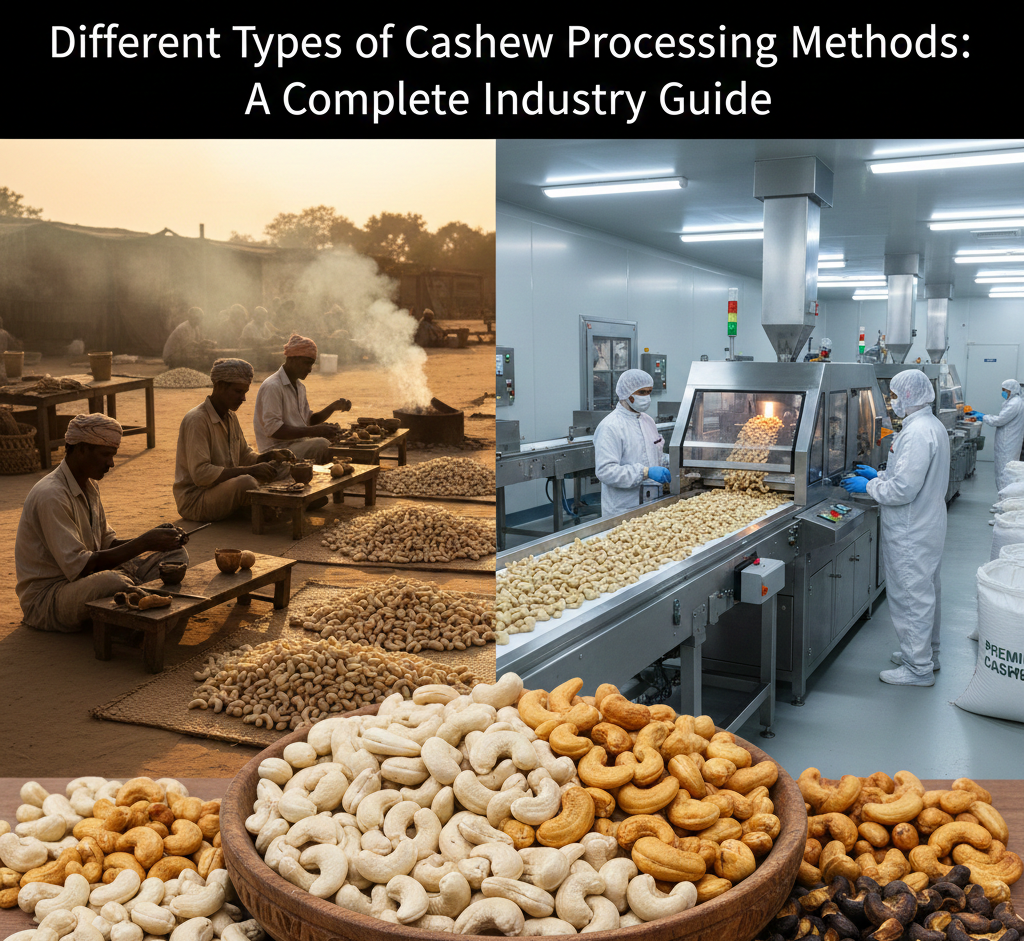
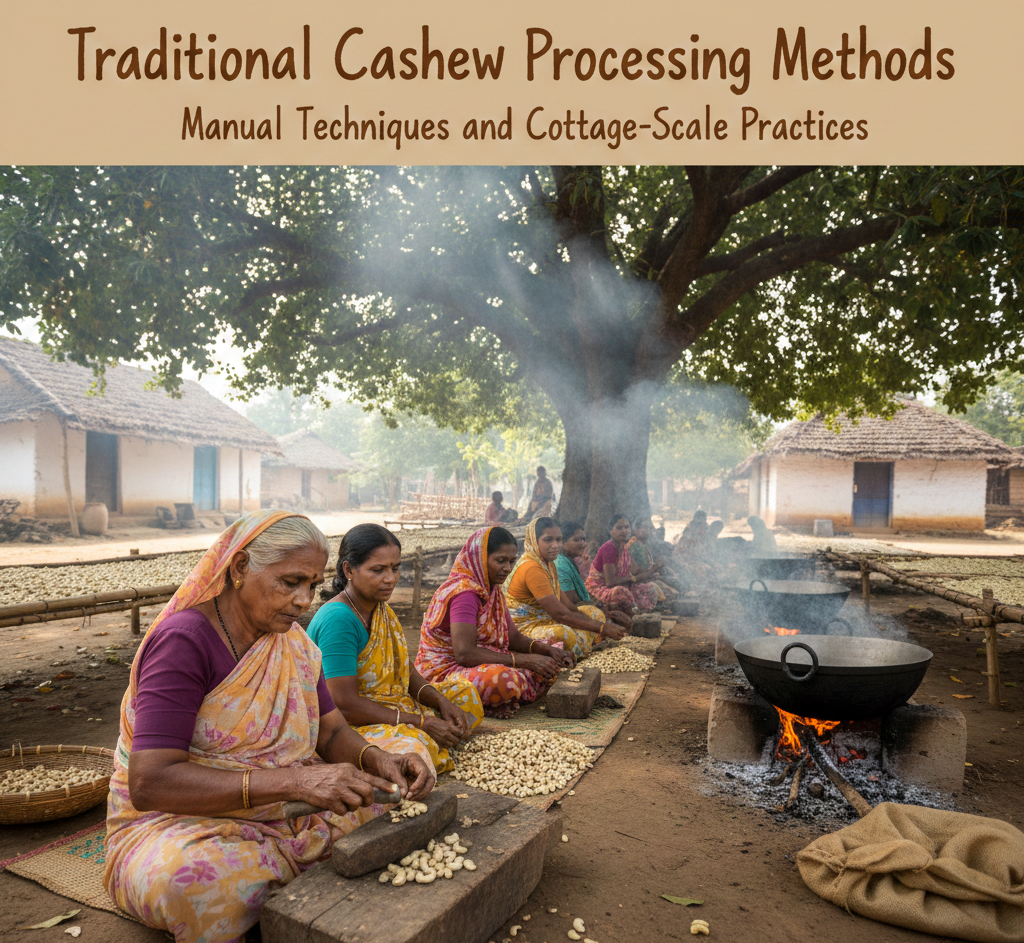
Compared to traditional open-pan roasting, drum roasting offers better efficiency and improved heat distribution. However, it does not provide the same level of safety, moisture control, or kernel integrity as steam roasting.
For processors unable to invest in full steam systems, drum roasting serves as an intermediate solution. It enhances productivity while keeping capital expenditure manageable.
Industry Relevance Today
In large export-focused facilities in countries like India and Vietnam, drum roasting has gradually been replaced by steam-based processing due to higher quality requirements.
However, in developing cashew-processing regions particularly across West Africa drum roasting continues to support medium-scale processors seeking cost-effective modernization.
It remains relevant where:
- Access to high-pressure steam systems is limited
- Fuel sources are affordable
- Export standards are moderate rather than premium
Strategic Considerations for Processors
For entrepreneurs evaluating different types of cashew processing methods, drum roasting represents a transitional technology. It offers measurable improvements over traditional systems while avoiding the full cost of steam infrastructure.
The method is most suitable for processors targeting regional markets or gradually scaling operations before investing in advanced automation.